
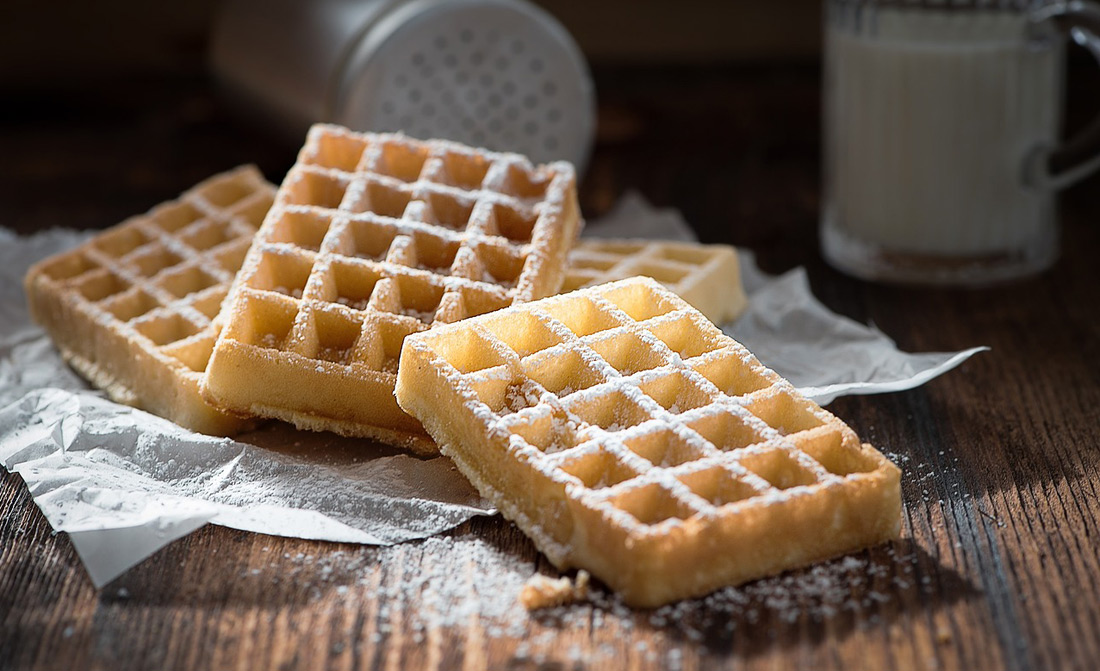
Waffles are among the world’s most popular treats, enjoyed for breakfast, as a dessert or as a street-food snack. Their batter is similar to pancake batter and can be made in both sweet and savoury versions. The waffle recipes below include examples of both, from classic breakfast waffles to more unusual savoury variations.
The History of Waffles
The history of waffles can be traced back to ancient Greece, where flat cakes known as obelios were cooked between hot metal plates. This method of cooking spread throughout medieval Europe. The cakes, made from a simple mixture of flour, water or milk and sometimes eggs, became known as wafers. They were cooked over open fires between iron plates attached to long handles.
Alongside these wafers, round cast-iron moulds, known as moules à oublies, became popular. Their patterned surfaces often featured biblical scenes or simple decorative motifs. The early oublies were made from little more than cereal flour and water. From around the 11th century, however, new flavours and spices introduced through trade and the Crusades began to appear in the batter, including orange blossom water.
By the 13th century, oublies had become widespread in north-western Europe. One of the earliest recorded waffle recipes dates from the 14th century. It included eggs, flour, salt and sweet wine, while another version also contained cheese. These cakes became known as gaufres in French. During the 15th century, they began to be cooked in rectangular irons with increasingly deep, grid-like patterns.
The batter used for the famous Brussels waffle developed during the 16th century and was originally leavened with beer yeast. By the 18th century, thinner waffles, sometimes flavoured with honey or made without added sweetness, were popular across Europe, while richer, sweeter varieties became fashionable among the aristocracy.
Many different recipes emerged, using yeast, sourdough starters or butter-enriched batters. Some relied on egg whites alone to create a lighter texture. The English word waffle is thought to have come from the Dutch wafel, and the name travelled to North America with Dutch settlers.
Types of Waffles
There are several traditional types of waffles, each made with a different batter and cooking method.
- Brussels waffles are made with a yeast-leavened batter, often incorporating whipped egg whites to give them a light, airy texture and crisp exterior. In Belgium, they are traditionally served warm, dusted with icing sugar, particularly by street vendors.
- Liège waffles are denser, sweeter and slightly chewy. They are made from a rich, brioche-style yeast dough containing butter and pearl sugar, which caramelises during cooking.
- American waffles are generally thinner and denser than traditional Belgian waffles. They are usually made with baking powder rather than yeast and often have a buttermilk-based batter. Ingredients such as nuts, chocolate chips and cinnamon can be added. In the United States, waffles are particularly popular for breakfast, often served with maple syrup and crispy bacon. They are also enjoyed as desserts with whipped cream, fruit compotes, sauces and ice cream.
- Belgian-style waffles are the North American interpretation of Belgian waffles, particularly the Brussels variety. They are typically made with a simpler batter, often using baking powder instead of yeast, and are cooked in deep-grid waffle irons.
- Bergische waffles are a speciality of the Bergisches Land region of Germany. Traditionally heart-shaped, they have a crisp exterior and are served with cherries and whipped cream, particularly on festive occasions.
- Asian waffles are popular street-food snacks in several parts of Asia, where they are sometimes referred to as grid cakes or waffle biscuits. Hong Kong-style egg waffles, also known as bubble waffles, have a distinctive pattern of small, rounded bubbles. Vietnamese waffles, on the other hand, often contain coconut milk, giving them a rich flavour and delicate aroma.
- Croffles are a more recent food trend, combining a croissant with a waffle. Made by pressing croissant dough in a waffle iron, they became particularly popular in South Korea, although the concept is also associated with cafés in Dublin and elsewhere.
Waffle Makers
To make waffles at home, you will need a waffle maker. There are several types available, from professional-style Belgian waffle makers with deep grids to thinner waffle irons designed for European-style waffles.
Traditional waffle makers come in different shapes, including round, square, heart and flower designs. Some models have interchangeable plates, allowing you to make waffles in different shapes and patterns. A multifunctional sandwich maker with interchangeable waffle plates can also be a practical option if you have limited kitchen space.
Before buying a waffle maker, consider how often you will use it, how many people you usually cook for, how much storage space you have and, of course, your budget. It is worth thinking about whether a dedicated appliance is a worthwhile investment or whether a multifunctional model would be sufficient.
A good waffle maker should have adjustable temperature settings so you can control how crisp or golden the waffles become. Its power rating, measured in watts, is also worth considering: a higher wattage generally means faster heating and cooking, although the design and heating efficiency of the appliance matter too.
Ease of cleaning is another important factor. Look for models with non-stick cooking plates, which help prevent the batter from sticking and make cleaning easier. Bear in mind that non-stick coatings can scratch, so avoid metal utensils and use silicone or wooden tools instead.
Waffle Batter
There are several ways to prepare waffle batter.
- Traditional recipes use yeast or a sourdough starter, but baking powder and bicarbonate of soda (baking soda in North America) are more commonly used in quick waffle recipes. These require no proving time and can be cooked straight away.
- Quick waffle batter is similar to the basic mixture used for American pancakes, although it is usually thicker to give the waffles their characteristic texture.
- You can enrich the batter with yoghurt, kefir, cream or cottage cheese. Ground walnuts, hazelnuts, almonds, desiccated coconut and rolled oats can be used alongside or instead of some of the flour. Grated or puréed fruit, jam, vanilla, cocoa powder, liqueurs and ground spices are also useful additions.
- Waffles do not have to be sweet. Savoury versions make excellent snacks, appetisers and party food. You can add grated cheese, herbs, vegetables and spices to the batter.
- For vegan waffles, use plant-based milk and replace the eggs with flax eggs or a commercial egg replacer. Gluten-free waffles can also be made using suitable gluten-free flour blends.
How to Make Waffles
- Always follow the manufacturer’s instructions for your waffle maker rather than relying solely on the cooking times given in individual recipes. Different appliances heat up and cook at different rates. The ideal cooking time will also depend on the type of batter and whether you prefer your waffles light and soft or golden and crisp.
- Make sure the batter is smooth and free of lumps. If time allows, leave it to rest before cooking. You can also prepare it in advance and refrigerate it overnight, provided the recipe allows for this.
- Preheat the waffle maker thoroughly before adding the batter. If the plates are not hot enough, the waffles may stick and cook unevenly. Avoid overfilling the moulds, as the batter will spread and spill over the edges as it cooks.
- Remove the waffles carefully using a silicone spatula or other non-metal utensil to avoid scratching the non-stick coating.
- If you prefer crispy waffles, place them on a wire rack as soon as they are cooked. Avoid stacking them on top of one another, as trapped steam will soften their crisp exterior.
How to Serve Waffles
- Waffles can be served whole or cut into smaller portions, depending on their shape. Heart-shaped and flower-shaped waffles, for example, are particularly attractive when served individually.
- There are countless ways to serve them. Sweet toppings include whipped cream, jam, melted chocolate, chocolate-hazelnut spread, sweetened cream cheese, yoghurt, fresh or preserved fruit, fruit compote, fruit mousse, custard, vanilla sauce, flavoured syrups, ice cream and so on. A simple dusting of icing sugar, cinnamon or cocoa powder is often all you need.
- You can also stack several waffles with cream, fruit or other fillings between the layers to create a waffle cake.
Storing and Reheating Waffles
- If you have leftover waffles, allow them to cool completely before storing them in an airtight container in the refrigerator. They can also be frozen for longer storage.
- To reheat them, simply place them in a toaster until warmed through and crisp again. Frozen waffles can usually be reheated directly from frozen, following your toaster manufacturer’s instructions.
And now try out our Waffle Recipes>>