
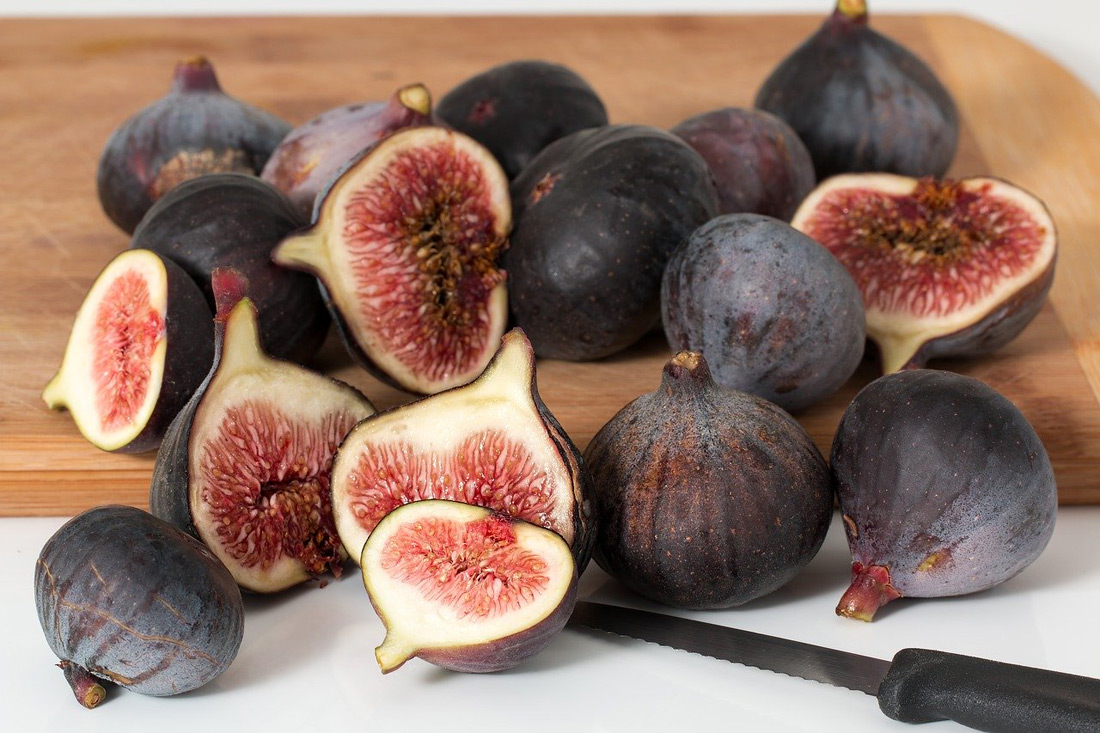
Figs have been enjoyed for thousands of years and remain an important ingredient in Mediterranean and Middle Eastern cooking. Their soft texture and honey-like sweetness make them delicious eaten fresh, but figs are just as useful in savoury dishes as they are in desserts. They pair particularly well with cheese, cured ham, nuts, herbs and roasted meat, while dried figs bring sweetness and depth to cakes, breads, stews and festive dishes. These fig recipes explore the many ways to use this distinctive fruit, from simple seasonal salads to baked treats and savoury combinations.
Figs: the fruit and the plant
- The common fig (Ficus carica) belongs to the mulberry family, Moraceae. It is a deciduous shrub or small tree native to an area stretching from the eastern Mediterranean to western Asia. Figs are among the oldest cultivated fruit crops, with a history that goes back thousands of years. They were valued by ancient civilisations not only as a fresh fruit but also because they could be dried and stored for use throughout the year.
- Botanically, a fig is unusual. What appears to be the fruit is actually a specialised, enclosed structure containing many tiny flowers. These develop into the small, crunchy structures commonly called seeds, which give the ripe fig its characteristic texture.
- There are hundreds of cultivated fig varieties, differing in size, shape, skin colour and flesh. Some have green or yellow-green skins, while others are brown, purple or almost black. The flesh can range from pale pink to deep red, depending on the variety and ripeness. Brown Turkey, Black Mission and Kadota are among the varieties grown commercially.
- Fig trees thrive in warm, sunny conditions and prefer a sheltered position. They are widely grown throughout Mediterranean countries and parts of the Middle East, but can also grow in cooler climates when planted in a suitable spot. In the UK, figs can be grown outdoors in sheltered gardens, particularly in warmer areas, although the ripening of the fruit depends on the variety and the weather.
Fig season
- Fresh figs are generally in season from late summer into autumn, although the exact timing varies with the climate and variety. In Mediterranean countries, some fig trees produce two crops a year: an earlier crop and a main crop later in the summer. Others produce just one main harvest.
- Fresh figs are widely available in British supermarkets and greengrocers during late summer and autumn. Outside the main season, imported figs may still be available, although their quality and price can vary. When figs are in season, they are worth buying for their delicate texture and fragrant sweetness.
Buying and storing figs
- Fresh figs are delicate and highly perishable, so it is best to buy them close to the time you intend to eat them. Choose plump fruits that feel slightly soft but are not collapsing or leaking. A pleasant, sweet fragrance is a good sign of ripeness. Avoid figs that are mouldy, slimy or have a sour, fermented smell. A few small wrinkles can be normal on a ripe fig, but extensive shrivelling may indicate that it is drying out.
- Handle figs carefully, as their soft flesh bruises easily. Store ripe figs in the refrigerator in a shallow container, ideally in a single layer, and eat them within a few days. For the best flavour, allow them to come to room temperature before serving. Figs that are still firm can be left at room temperature to soften, but they should be checked frequently.
- Figs can be eaten with or without their skins. The skin of most edible varieties is perfectly suitable to eat, although some people prefer to peel figs with thicker skins. Wash them gently just before serving.
Dried figs
- Drying is one of the oldest ways of preserving figs. Dried figs have a more concentrated sweetness and a chewier texture than fresh ones, making them useful throughout the year. They are especially popular in Turkey, North Africa and the Middle East, where they are eaten as a snack and incorporated into both sweet and savoury dishes.
- Choose dried figs that are soft and pliable, with no signs of mould or an unusual smell. Store them in an airtight container in a cool, dark place, following the packaging instructions. They can also be refrigerated to help maintain their quality.
- Dried figs work well in porridge, muesli, granola, fruit cakes, biscuits and homemade energy bars. They can be chopped into bread dough or simmered with onions, vinegar and spices to make a chutney. They also pair beautifully with walnuts, almonds, pistachios, cinnamon, cardamom and orange zest.
- Because drying removes much of the water, dried figs contain more calories, natural sugars and fibre per 100 g than fresh figs. They are nutritious and filling, but a smaller portion is often sufficient.
Nutritional value and health benefits
Figs provide fibre, natural sugars and a range of vitamins, minerals and plant compounds. Their nutritional profile differs considerably depending on whether they are eaten fresh or dried.
- Fibre and digestion. Figs contain dietary fibre, which contributes to normal bowel function. Eating fibre-rich foods as part of a balanced diet, together with adequate fluids, can help maintain regularity. Dried figs provide more fibre per 100 g than fresh figs, but large portions may cause bloating or diarrhoea in some people.
- Vitamins and minerals. Figs provide smaller amounts of several vitamins, including vitamin K and some B vitamins, along with minerals such as potassium, calcium and magnesium. The quantities vary by variety and ripeness, and dried figs are more concentrated because they contain less water. Figs can contribute to a varied diet, although they should not be relied on as the sole or main source of any particular nutrient.
- Plant compounds. Figs contain polyphenols and other naturally occurring plant compounds. Some of these have antioxidant activity in laboratory studies, and the composition varies between varieties. This does not mean that eating figs can prevent or treat specific diseases; their value is best understood as part of an overall balanced diet.
- Calories and natural sugars. Fresh figs contain approximately 70–80 kcal per 100g, while dried figs typically provide around 240–260 kcal per 100g. Both contain natural sugars, but these are more concentrated in dried fruit. Portion size may be particularly relevant for people managing their blood glucose levels.
- Figs also contain calcium and magnesium, which contribute to the maintenance of normal bones and teeth. However, although figs can contribute these minerals to the diet, eating them alone cannot prevent osteoporosis or replace other important aspects of bone health.
Figs in history and traditional medicine
- Figs were an important food in ancient Egypt, Greece and Rome. Their sweetness, availability and suitability for drying made them valuable at a time when preserving fresh produce was difficult. Alongside grapes, olives and grains, they became a familiar part of traditional Mediterranean food culture.
- The fig tree also has a place in religious stories and cultural traditions. It appears in the Bible and was associated with abundance and fertility in some ancient cultures. Figs were sometimes regarded as aphrodisiacs, although this belief is rooted in tradition rather than strong scientific evidence.
- In traditional medicine, figs were commonly eaten to help relieve constipation, a use that is consistent with their fibre content. They have also featured in various folk remedies, but traditional use should not be confused with proof that figs can treat illness.
How to use figs in cooking
- Figs are particularly versatile because their sweetness works in both sweet and savoury dishes. Fresh figs can be eaten on their own, sliced over yoghurt or porridge, or served with honey, ricotta, pistachios or walnuts for a simple dessert. They are also excellent in cakes, tarts, fruit salads and baked puddings.
- One of the best ways to enjoy fresh figs is to combine them with savoury ingredients. Their sweetness balances the saltiness of cured ham, the tang of goat’s cheese and the richness of blue cheese. Try halved figs with Parma ham, or bake them briefly with goat’s cheese and walnuts. They also make an excellent addition to salads with rocket, toasted nuts, cheese and a balsamic dressing.
- Figs pair well with poultry, duck and lamb. They can be roasted alongside meat, added to sauces or used in glazes. In Middle Eastern and North African cooking, dried figs may be added to couscous, pilafs, stuffings and slow-cooked meat stews, where they provide sweetness alongside warming spices.
- They can also be used on savoury flatbreads and pizzas. Combine fresh figs with goat’s cheese or blue cheese, caramelised onions, walnuts or rosemary for a sweet-and-savoury topping. For pasta dishes, figs work best when balanced with robust flavours such as cheese, nuts, herbs or a little balsamic vinegar.
- Dried figs are particularly useful in autumn and winter cooking. Chop them into fruit cakes, biscuits, breads and festive bakes, or simmer them with onions, ginger, chilli and vinegar to make a chutney for cheese boards and roasted meats. They can also be added to porridge, yoghurt, homemade granola and snack bars.
- Figs can be made into jam, preserves, compotes and fruit sauces. Fresh figs produce a fragrant, sweet preserve, while dried figs can be simmered with liquid and spices to make a thick accompaniment for cheese or meat.
- Whether you choose fresh figs for salads, desserts and savoury dishes or dried figs for baking and slow-cooked meals, this ancient fruit offers plenty of possibilities.
Explore our fig recipes for more ideas on making the most of both fresh and dried figs>>